
Two months ago, Chief Justice Roberts began the Court's opinion in Bost v. Illinois State Board of Elections this way:
Under Article III of the Constitution, plaintiffs must have a "personal stake" in a case to have standing to sue. FDA v. Alliance for Hippocratic Medicine, 602 U.S. 367, 379, 144 S.Ct. 1540, 219 L.Ed.2d 121 (2024). They must, in other words, be able to answer a basic question: " 'What's it to you?' " A. Scalia, The Doctrine of Standing as an Essential Element of the Separation of Powers, 17 Suffolk U. L. Rev. 881, 882 (1983)
These sentences should be enough to reverse Judge Leon's injunction blocking the construction of the new East Wing ballroom.
I'm sure you've seen many press stories about today's opinion, but have you actually read the standing analysis? In an earlier ruling, the court relied on a purported aesthetic injury.
A member of the National Trust regularly walks near the White House, and enjoys the beauty of the architecture. But she doesn't like the new design. This distress, she claims, gives her Article III standing to challenge the construction at the White House. She has no monetary interest. Rather, she simply doesn't like how the structure appears.
Hoagland intends to continue visiting President's Park roughly once a month. Id. at 12. She asserts that construction of a ballroom of the form and scale proposed by the President would disrupt her enjoyment and use of President's Park and cause her to "suffer both professional and personal injuries, including to [her] aesthetic, cultural, and historical interests." Id. at 13-14. The President's proposed ballroom would, in Hoagland's words, "overshadow[]" the White House and "diminish [its] primacy," thereby disrupting the message that "our president lives in a house." Id. at 13. Based on her claims of aesthetic injury, Hoagland could sue in her own right. It is well-settled that the "desire to use or observe" something, "even for purely [a]esthetic purposes, is undeniably a cognizable interest for purpose of standing." Lujan, 504 U.S. at 562-63.
The plaintiff is distressed by what she might have to see. To use Justice Gorsuch's phrasing, Hogland is an "offended observer." Here is how Gorsuch described the doctrine in American Legion:
"If individuals and groups could invoke the authority of a federal court to forbid what they dislike for no more reason than they dislike it, . . . [c]ourts would start to look more like legislatures, responding to social pressures rather than remedying concrete harms . . . ."
I am very familiar with the aesthetic injury claim. It was raised in the Mifepristone litigation. Judge Ho expressly invoked it in his concurrence.
In addition to the injuries analyzed by the majority, Plaintiffs have demonstrated another basis for Article III standing: the aesthetic injury they experience in the course of their work. See, e.g., Sierra Club v. Morton, 405 U.S. 727, 734-35, 92 S.Ct. 1361, 31 L.Ed.2d 636 (1972) (recognizing aesthetic harm as "injury to a cognizable interest"); Lujan v. Defs. of Wildlife, 504 U.S. 555, 562-63, 112 S.Ct. 2130, 119 L.Ed.2d 351 (1992) ("[T]he desire to use or observe an animal species, even for purely esthetic purposes, is undeniably a cognizable interest for purpose of standing."); id. at 566, 112 S.Ct. 2130 ("[T]he person who observes or works with a particular animal threatened by a federal decision is facing perceptible harm."). It's well established that, if a plaintiff has "concrete plans" to visit an animal's habitat and view that animal, that plaintiff suffers aesthetic injury when an agency has approved a project that threatens the animal. See Lujan, 504 U.S. at 564, 112 S.Ct. 2130. . . .
Unborn babies are a source of profound joy for those who view them. Expectant parents eagerly share ultrasound photos with loved ones. Friends and family cheer at the sight of an unborn child. Doctors delight in working with their unborn patients—and experience an aesthetic injury when they are aborted.
Plaintiffs' declarations illustrate that they experience aesthetic injury from the destruction of unborn life.
In short, if naturalists can claim an aesthetic injury to see plants and animals, then pro-life doctors could claim a similar injury with regard to newborn babies.
On appeal, the Supreme Court could have considered AHM's "aesthetic" standing argument raised in Judge Ho's concurrence. But Justice Kavanaugh did not. The ground for standing was not even mentioned. Indeed, I think the Court chipped away at "offended observer" standing in Footnote 3:
The doctors also suggest that they are distressed by others' use of mifepristone and by emergency abortions. It is not clear that this alleged injury is distinct from the alleged conscience injury. But even if it is, this Court has long made clear that distress at or disagreement with the activities of others is not a basis under Article III for a plaintiff to bring a federal lawsuit challenging the legality of a government regulation allowing those activities. See, e.g., Valley Forge Christian College v. Americans United for Separation of Church and State, Inc., 454 U. S. 464, 473, 485–486 (1982); United States v. Richardson, 418 U. S. 166, 175 (1974); Sierra Club v. Morton, 405 U. S. 727, 739 (1972).
What is the relationship between Mifepristone and the Ballroom? Are we to believe that an astute art critic can claim an "aesthetic" injury for staring at slabs of marble but a doctor cannot claim an "aesthetic" injury for seeing the miracle of life? This would be yet another asymmetry in standing. Offended liberals can always get to federal court but conservatives cannot.
I do not see how a claim for "aesthetic injury" is consistent with the Court's recent standing cases--especially when the claim is based on subjective architectural sensibilities. To borrow from The Fountainhead, we can call this doctrine "Ellsworth Toohey" standing.

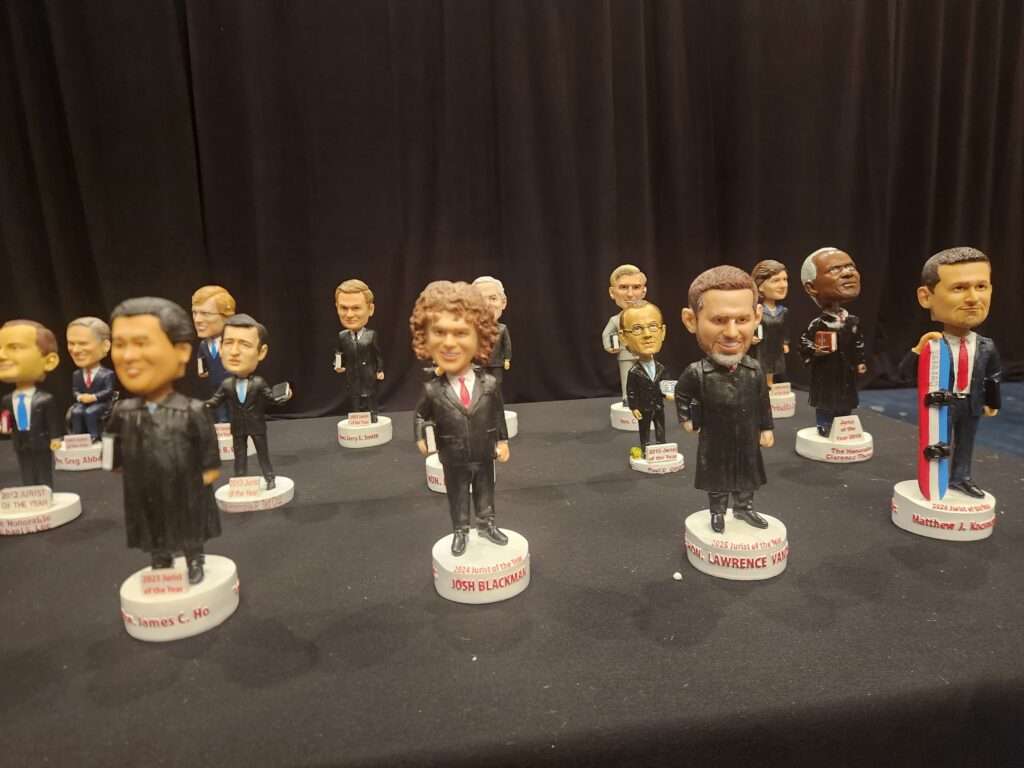 On Saturday evening, the Texas Review of Law & Politics awarded its 2026 Jurist of the Year award to Judge Kacsmaryk. The latest bobblehead has a perfectly coifed head of hair, far different from the mop atop the 2024 winner.